At StartStak, we’re building a product-led company from the ground up. We already offer AI-native go-to-market services to help companies build and scale, and now we’re developing a product for founders navigating the zero to $3M journey on their path to product-market fit.
One thing became clear early on: in a PLG (Product-led Growth) motion, Customer Success can’t be an add-on – it has to be built into the product experience itself. And that makes it look very different from traditional CS models.
In most companies, Customer Success steps in after a sale. They onboard the customer, check in at predetermined intervals, respond to support issues, and try to drive retention. But in PLG, there’s no handoff from Sales. There may not even be a human touchpoint early on. Customers often explore, try, and adopt your product on their own. That means CS has to show up within the product – without the customer ever asking for it.
We started by building a customer journey map for our first persona. Yes, that’s a CS staple in any model – but in PLG, the output becomes even more tightly connected to how the product is built and marketed. We didn’t just map stages – we focused on what the customer is trying to accomplish at each point, what “success” looks like in their eyes, and where they might get stuck if we’re not careful.
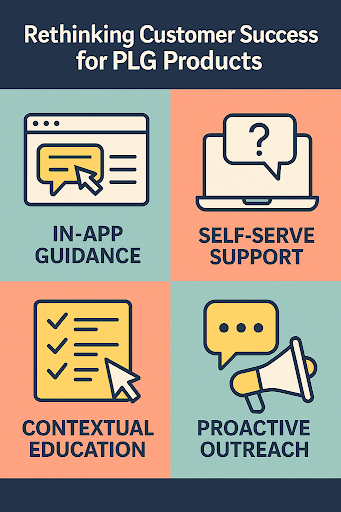
From there, we worked closely across product, content, and marketing to think about what the experience should look like without relying on humans to step in. That meant figuring out where the product could guide, where content could educate or unblock, and where subtle tips could nudge the user forward – right when they need it.
We also identified the key analytics that will tell us if customers are actually moving through those milestones. These aren’t just usage stats – they’re signals of progress, friction, or drop-off. In PLG, you can’t rely on a CSM to tell you how things are going. You have to build in those listening points, so the product can respond in real time.
And then there’s support. In a PLG motion, it’s not about assigning a person to help. It’s about making sure help shows up when and where the customer needs it – whether that’s through guidance in the product, contextual content, or scalable forms of education and community. The goal isn’t to be available for every customer – it’s to make them feel like they don’t need to ask for help in the first place.
That’s how we’re thinking about Customer Success at StartStak. In a PLG world, it’s not a team that takes over after the fact – it’s a mindset you design into the product from day one.
This blog post expresses the opinions of the author, not South Asian Success.
Feature graphic generated using ChatGPT.